• Skip to main content
  • Skip to footer

Shore Point Productions

Video, Photography & Content Marketing That Grows Your Business

  • Home
  • Our Services
    • Content Marketing Campaigns
    • Video Production
    • Commercial Photography
    • Podcast Production & Management
  • Industries
    • Healthcare
    • Non-Profits
  • Our Work
  • Learning Center
    • Video Content Strategy: How to Get More From One Shoot
    • Kickstart Your Video Marketing With These 5 Videos
    • How Videos Increase Consumer Trust
    • 5 Things To Consider When Looking for a Video Production Company
  • Meet The Team
  • Contact
You are here: Home / Posts

Posts

Jul 10 2026

Kickstart Your Video Marketing With These 5 Videos

5-Types-of-Video-for-Business

In today’s rapidly evolving digital landscape, video marketing has emerged as a paramount tool for all marketers. It offers a dynamic way to captivate audiences, deliver compelling messages, and boost brand awareness and engagement. Video marketers are continually searching for the most effective types of videos to propel their strategies forward. In this article, we will delve into five video types that prove to be indispensable for marketers, shedding light on how each type can bolster brand presence and drive impressive results.

Brand Story/About Us Videos

Every brand has a unique story to tell, and a brand story or “About Us” video is the ideal medium for sharing that narrative. These videos provide an intimate glimpse into the company’s history, values, mission, and culture. By conveying this core identity, a brand story video can form a profound connection with the audience.

Key benefits of Brand Story/About Us Videos:

  • Brand Identity: A compelling brand story video helps solidify a distinct identity, making your brand memorable and relatable.
  • Emotional Engagement: Stories have a way of resonating with emotions. A well-crafted brand story video can leave a lasting impact on your audience.
  • Trust Building: Sharing your journey and values demonstrates transparency and builds trust with potential customers.
  • Differentiation: In a crowded marketplace, your unique story can set you apart from competitors.

Brand story videos are an essential tool in your video marketing arsenal. They breathe life into your brand, engaging your audience on a deeper level.

Testimonial Videos

In the realm of marketing, the power of social proof cannot be overstated. Testimonial videos are a potent means of showcasing satisfied customers and the success stories associated with your brand, product, or service. These videos feature real individuals sharing their authentic experiences, thereby building trust and credibility.

Why testimonial videos are invaluable for marketers:

  • Trust Building: When potential customers witness real people endorsing your product or service, they are more likely to trust your brand and make a purchase.
  • Problem-Solution Demonstration: Testimonial videos can illustrate how your offering resolved a specific issue for a customer, making them relatable to prospects facing similar challenges.
  • Educational Content: Testimonial videos serve as both promotional and educational content, offering valuable insights for potential buyers.
  • Conversion Catalyst: These videos can overcome objections and guide potential customers further down the sales funnel.

Harness the persuasive force of satisfied customers to enhance brand credibility and sway purchasing decisions with well-crafted testimonial videos.

Explainer Videos

Explainer videos are the Swiss Army knives of video marketing. They are designed to distill intricate ideas, products, or services into a simple, visually engaging format that anyone can comprehend. These concise and compelling videos are highly effective for introducing your brand, conveying your value proposition, and helping customers understand what you have to offer.

The key advantages of explainer videos:

  • Clarity and Conciseness: Explainer videos cut through complexity, making it easy for your audience to grasp your message quickly.
  • Increased Conversion Rates: Incorporating an explainer video on your website’s landing page can significantly boost conversion rates, as it quickly informs visitors about your offerings.
  • Enhanced SEO: Search engines favor video content, so using explainer videos on your website can improve your search engine rankings and visibility.
  • Brand Consistency: Explainer videos offer a chance to convey your brand’s voice, style, and values consistently across various platforms.

No matter if you are a B2B or B2C marketer, explainer videos can help you simplify complex concepts and connect with your audience more effectively.

Employee Profile Videos

Behind every successful brand, there’s a team of dedicated individuals. Employee profile videos shine a spotlight on the people who drive your company’s success. These videos provide a personal touch by introducing your audience to the faces and voices behind your brand, fostering a deeper connection.

Benefits of Employee Profile Videos:

  • Humanizing the Brand: Employee profile videos humanize your brand, showing the people who work tirelessly to bring your products or services to life.
  • Trust and Credibility: By showcasing the expertise and dedication of your team, you build trust and credibility with your audience.
  • Recruitment Tool: Employee profile videos can also serve as recruitment tools, attracting top talent to your organization.
  • Foster Team Morale: These videos can boost employee morale and engagement by giving them a sense of pride in their work and the company.

Including employee profile videos in your video marketing strategy can create a more personal connection with your audience and highlight your team’s expertise.

Commercial Videos

While the term “commercial” might evoke traditional television advertisements, modern commercial videos extend to a broad spectrum of digital marketing formats. These videos are typically short, snappy, and designed to grab the viewer’s attention in a brief span. Commercial videos can promote specific products, services, events, or offers and are an excellent tool for driving conversions.

Why marketers should embrace commercial videos:

  • High Engagement: Their concise format makes commercial videos highly engaging and suitable for social media and online ad platforms.
  • Call to Action (CTA): These videos can directly prompt viewers to take action, such as making a purchase, signing up for a newsletter, or attending an event.
  • Brand Awareness: Quick and impactful commercial videos can help raise brand awareness and introduce your products to a wider audience.
  • Diverse Formats: Commercial videos can take various forms, from animated ads to live-action shots, allowing for creativity and experimentation.

Conclusion

For video marketers, selecting the right video types is crucial for achieving their marketing objectives. Each of the five video types discussed in this article serves a unique purpose, catering to different aspects of a comprehensive marketing strategy. Whether you are seeking to convey your brand’s story, build trust through testimonials, clarify your offerings with explainer videos, establish personal connections with employee profiles, or drive direct conversions with commercial videos, the right video can make all the difference.

By integrating these video types into your marketing strategy, marketers can create a more engaging and impactful brand presence. The most effective video marketing strategies often incorporate a blend of these video types, tailored to specific goals and target audiences. As you embark on your video marketing journey, remember that the right video, at the right time, can take your marketing efforts to the next level.
Written by spproductions · Categorized: Uncategorized · Tagged: how to, marketing, strategy, types of video, video marketing, videos for business

Oct 19 2026

Video Content Strategy: How to Get More From One Shoot

Video Content Strategy

Video Content Strategy: How to Get More From One Shoot

When a company invests in professional video production, the conversation usually starts with one deliverable: a brand film, a testimonial, or a recruitment video.

But there’s often an opportunity to create much more.

If you’re already coordinating interviews, booking locations, and bringing in a production crew, it makes sense to consider what additional content could come from that same shoot.

That’s where a thoughtful video content strategy makes a difference. Instead of planning around a single finished video, you can approach production as an opportunity to create multiple marketing assets that support your business long after filming wraps.

Start With a Clear Video Content Strategy

Before developing a shot list or scheduling interviews, start with a simple question: What are we trying to accomplish?

Are you building brand awareness? Launching a new service? Recruiting employees? Helping prospective customers understand what makes your organization different?

The answers should shape your production plan.

For example, a company producing a recruitment video might also benefit from individual employee testimonials, workplace photography, leadership interviews, and short-form videos highlighting its culture.

All of those assets serve the same larger objective, but they give the marketing team different ways to reach prospective candidates.

A strong video marketing strategy connects those individual pieces rather than treating every deliverable as a separate project.

Think Beyond the Main Video

Let’s say your organization is planning a corporate brand film.

You’ve scheduled leadership interviews, arranged access to your facilities, and coordinated a day of filming.

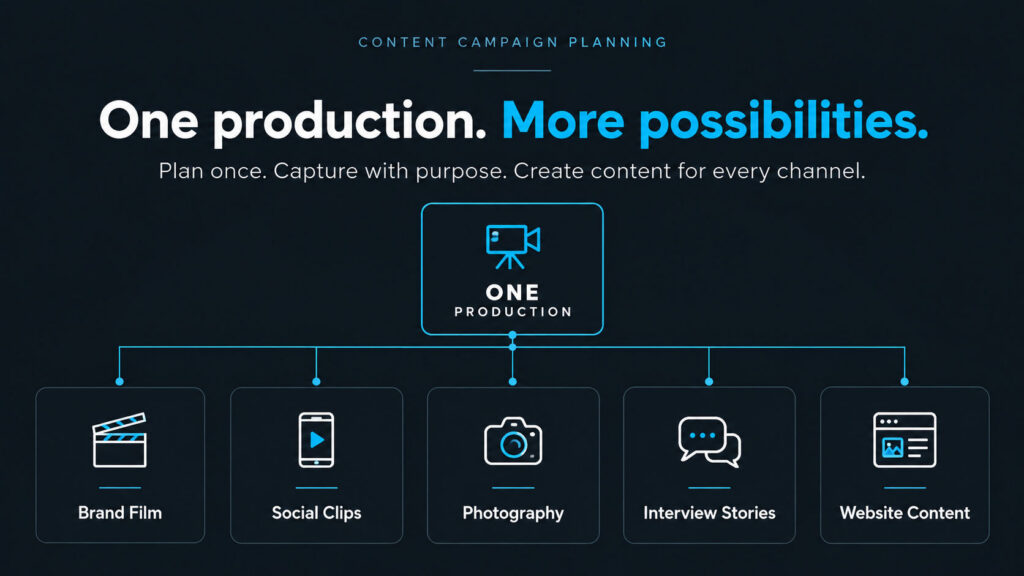
With some additional pre-production planning, you could potentially create:

  • Brand Film: A polished video introducing your organization, mission, and value to customers.
  • Social Media Videos: Shorter edits featuring specific messages, services, or interview moments.
  • Employee or Customer Testimonials: Individual stories that can support recruitment, sales, or brand awareness campaigns.
  • Corporate Photography: Executive portraits, workplace imagery, and brand photography for websites and marketing materials.
  • Website Content: Supporting video clips, interview excerpts, and visuals for landing pages and digital campaigns.

Of course, not every shoot needs all these deliverables. Additional photography may require a dedicated photographer, and capturing more interviews or footage could mean extending the production schedule.

The point isn’t to squeeze as much content as possible into one day. It’s to identify the opportunities ahead of time and plan accordingly.

When done well, this approach can help make your production investment more useful across multiple marketing initiatives.

Plan Your Video Content Strategy for Multiple Platforms

A video designed for your website isn’t necessarily the ideal format for LinkedIn, Instagram, or YouTube.

Different platforms call for different approaches to length, framing, pacing, and messaging.

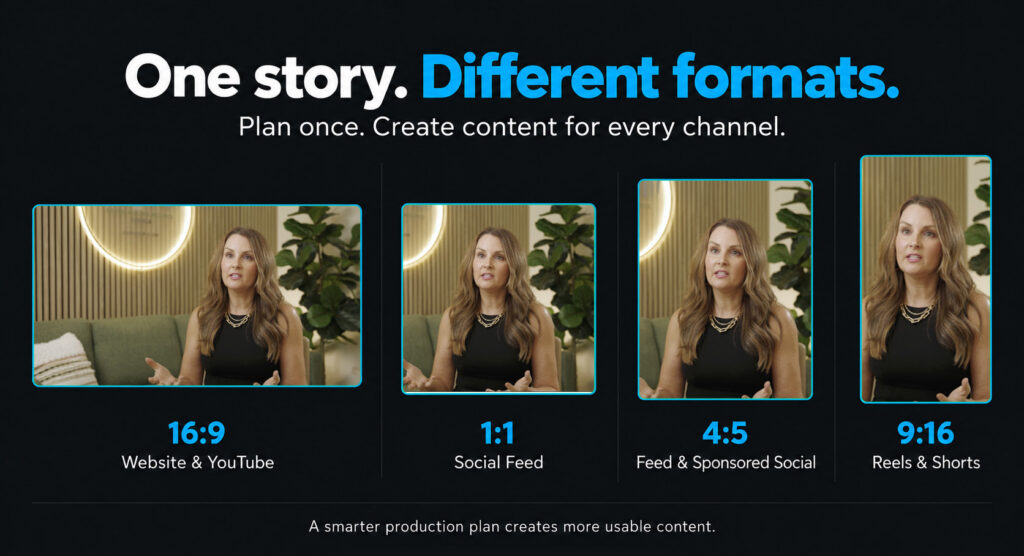
For example, a corporate brand film might be produced in a traditional 16:9 widescreen format, while social media content could require square (1:1), portrait (4:5), or vertical (9:16) versions.

YouTube also categorizes eligible square and vertical videos up to three minutes as Shorts, as outlined in its official YouTube Shorts guidelines.

These are details worth considering before filming begins.

If you’re planning vertical social content, your camera operator may need to frame shots differently, allowing enough room to crop a widescreen image without cutting off important visual elements.

Interviews can also be structured to capture shorter, self-contained answers that make sense outside the longer video.

Planning for multi-platform video content during pre-production gives your editing team more flexibility and creates a better starting point for each deliverable.

video content strategy

Build a Content Library You Can Continue Using

Not everything captured during a production needs to be published immediately.

For organizations with ongoing marketing needs, there’s real value in building a library of professional video and photography assets.

Interview footage, workplace visuals, product demonstrations, and supporting B-roll can all become useful resources for future marketing campaigns.

We’ve seen the importance of this firsthand at Shore Point Productions.

Over four years, we’ve filmed more than 300 physician biography videos for Hackensack Meridian Health. We also produced approximately 70 residency and fellowship program videos within a four-month period.

Projects of this scale require more than good cinematography. They depend on organized production schedules, consistent creative execution, and a reliable approach to managing large volumes of content.

An effective video content strategy should consider not only what you’re creating today, but how that content will be organized, maintained, and used moving forward.

For marketing teams managing multiple departments, services, or ongoing campaigns, that preparation can make a significant difference.

Repurpose Video Content With a Purpose

Content repurposing doesn’t simply mean cutting a long video into a dozen shorter clips.

Each piece should have a reason to exist.

A 30-second employee testimonial might support a recruitment campaign. A short leadership interview could become a LinkedIn post. A compelling brand film excerpt might help introduce a service on your website.

The strongest approach is to identify the audiences, messages, and intended platforms for those assets before editing begins.

This helps your team create content that feels intentional rather than producing variations simply to increase the number of deliverables.

And while having more content can be useful, quality and relevance should always come first.

Five well-planned videos that support clear marketing objectives may provide more value than twenty clips with no defined purpose.

Measure the Success of Your Content Marketing Campaign

Once your content is published, the next step is understanding how it’s performing.

That starts with defining what success looks like for your organization.

If your goal is brand awareness, video reach and audience engagement may be important. If you’re developing a recruitment campaign, applications or visits to your careers page may matter more.

For a campaign designed to generate new business, website inquiries and qualified leads might be your primary indicators.

There isn’t one metric that tells the whole story.

A thoughtful video content strategy considers both the creative deliverables and the business objectives they’re intended to support.

Reviewing those outcomes also helps inform your next production, allowing you to build on what works rather than starting from scratch.

Make Your Next Production Work Harder

The next time you’re planning a professional video shoot, think beyond the immediate deliverable.

Consider where the content will be used, who needs to see it, and what other assets could support your marketing goals.

Bring those ideas into the conversation early. Work with your production team to prioritize the opportunities that make sense for your timeline and budget.

A smarter video content strategy isn’t necessarily about producing more. It’s about creating the right content and making the most of every production.

At Shore Point Productions, we help organizations develop and execute strategic content marketing campaigns through professional video production, commercial photography, and digital content creation.

Whether you’re planning a single brand film or a larger content initiative, we’d love to hear what you’re working on.

Explore Our Services | Discuss Your Project

Written by spproductions · Categorized: Uncategorized

Jan 26 2024

How to Choose Between Interview or Voice Over for Your Next Video

How to Choose Between Interview or Voice Over for Your Next Video

Sometimes it’s easy to choose what narration style will best suit your video. For example, if you are filming a testimonial you would want to use an interview, while training videos on the other hand would require voice over. But the answer is not always so obvious, and it’s not always one over the other. Some videos can use both and others require none, they just rely on text alone. For when the answer is not so obvious, here are some “food for thought” questions you can ask yourself to see which option works best for your next video!

Do you need someone people can relate to? Studies show that 91.7% of ads featuring a person’s face attracted more attention than those without. People tend to take social cues by reading another person’s emotions through their facial expressions. Since we were born we have been looking for that human connection. 

Voice Over or Interview
The difference between a voice over and interview narrative can have a big impact on connection with the viewer.

Is there an important person that needs to be interviewed for your video? Sometimes it’s who’s saying it that matters as much as what’s being said. A con of doing an interview, is you never have full control over an interviewee, they may have issues once a camera is in front of them. This is where voice over and other visuals may swoop in and help save the video. 

Do you quickly and efficiently need to deliver a complex message? If you know exactly what you want said and how you want it said, a voiceover is the perfect option. The feel, how they pace themselves can convey the point you want exactly how you want it. This then leaves room for visuals, which studies show that when an image is added to a piece of content understanding goes up from 70% to 95%. So not only are you grabbing people’s attention visually but also feeding them the narrative you want through words. 

At the end of the day, this choice is between you and the production team you hire. Which is why you want to find a production team that will hear your story and take your business to the next level. If you need guidance on what to look for in a production company click here to see what 5 things you should consider while on the hunt!

Written by spproductions · Categorized: Production

Jan 26 2024

How Video Marketing Helps Small Business

Video marketing is a crucial tool to building your business. Nowadays your audience is expecting it, studies show that 72% percent of people prefer watching a video to learn about a product or service. There are a lot of bonuses to video marketing, it can help improve your online presence, it can promote better brand awareness, it boosts engagement and builds trust. 

76% of video marketers report that video helped them increase sales, and 93% of businesses report gaining a new customer as a direct result of a video posted on social media. How many times have you been scrolling on your favorite social media platform, an engaging product video catches your attention and you’re hooked – you want it, you need it! Next thing you know you’re clicking the link, adding it to the cart, and hitting check out within seconds!

Major corporations know the power of video – millions of dollars are spent every year to advertise during the Super Bowl! Now, depending on what your needs are, it can be relatively inexpensive with high returns. As a small business creating a video you can use to advertise online, on your website, social media platforms, and email marketing campaigns should be top priority to help with wherever you are in the marketing funnel.

There are many different opportunities when it comes to creating video content. You want to make sure the communication is tailored properly to where your target audience is spending their time and where their eyes are focused. Your goals, target audience, and distribution channels all have an impact on what kind of video would benefit you the most. There’s long form content such as educational videos, branded short films, story based testimonials, or company culture videos. There is shorter content such as commercials or product videos. Then there’s microcontent that works well on social media such as Instagram, Facebook, and TikTok. These are just a few types of videos that can be created.

Video marketing costs both time and money and with that there’s no doubt an expectation of results. The bottom line is you need to have a plan and strategy on how to implement your video in marketing. Will you post it to social media to only just get a bunch of views and likes? The ultimate goal is to generate leads and sales. A combination of video strategy and distribution is key to justifying spending any money on content creation. 

Having a business large or small is no easy feat. Maybe you’ve invested in video which didn’t return measurable results or are just considering taking your marketing to the next level. Regardless of the route you take, make sure there is a strategy with a plan, purpose, and measurable results. We live in a day and age where consumers eat up video left and right, which undeniably can help increase sales. Find the right video marketing team that can align with your vision, will take your brand’s message and put it in front of the right audience, and get you the results and business your brand deserves. When all is said and done, the video really isn’t the product you’re purchasing, it’s the communication. 

Take your business to the next level.

Written by spproductions · Categorized: Uncategorized · Tagged: strategy, video marketing

Jan 22 2024

5 Things To Consider When Looking for a Video Production Company

5 Things To Consider When Looking for a Video Production Company 

Choosing a Production Company

Looking For A Video Production Company and don’t know what to look for? We’ve got you covered!

You have your brand and you’re ready to broadcast it to the world and we are here to cheer you on! Now where do you start? 

Not all video production companies are created equal! Finding out what is important to know and ask is a great starting point to figuring out who is the best fit to work with.

This article will talk about five different points to consider when looking into video production companies.

  1. Niche

It’s important to find out what focus and experience the video production company has. It’s not uncommon to find a company with a niche – maybe their focus is working with musicians and creating music videos, maybe it’s more of a corporate video focus. Then of course there are always the narrative and short film creatives that aim to get into the Cannes Film Festival and make it in Hollywood. We’ll put it like this… Say you’re craving a pizza, but not just any pizza, a grandma style vodka sauce pizza with chunks of mozzarella on top. Pause We’re drooling already. Now that you know what you want you just have to go get it so you head to a sushi bar, which says they’ll accommodate your request. Would you trust the chef to make that pizza or get what you actually wanted? Probably not.

When looking for a video production company you want one that best fits you and specializes in what you need produced. Know what type of content you need created, or at least have an idea. Finding a production company who has the proper experience can be a huge advantage when it comes to working with them to create relevant content for your target audience. Be sure to ask questions about past work and what they think is the best kind of content to create for your area of expertise – this way you know they can deliver the pizza… err video you wanted!

2. Portfolio

Video Portfolio
Video Portfolio

Ok now that you ordered your pizza and are back, we promise not to use any more food analogies. Looking through a company’s portfolio helps you to see what they offer. Often a production company will have a “reel” which highlights different productions they have worked on. Obviously looking into content they share on their website and social media is a great start, it’s also recommended to reach out and ask about any sample work they can share. It’s not uncommon for video production companies to not publicly share all their content. 

When looking at someone’s portfolio there are several things to consider. The visual appearance of their work is indicative of camera quality, lighting, and the skills of the people behind the scenes. Granted making things look good is usually not the hard part when it comes to video production.

A bonus of perusing a portfolio, you can use concepts from past works as inspiration for your production needs as well!  

3. Professionalism  

Looking into professionalism is extremely important and takes a certain level of observation and question asking on your end. Professionalism isn’t necessarily only how they may carry themselves and appear as a company. If you’re looking for video production that means you plan on investing your time, money, and energy. Make sure you save yourself potential headaches and consider the following when choosing a video production company. It’s very easy to get a video camera, start creating content, and call yourself a production company – but what does experience and professionalism entail?

Behind the shooting video production and lighting set for filming.

Ask what the production company does to prevent losing data. What if a microphone suddenly stops working and the audio is missed from an interview that cannot be easily filmed again? What if a memory card is corrupt and video files are lost. Will the entire production have to be recreated? Preventative measures are extremely important in every step of the way. Here at Shore Point Productions we make sure to record multiple sources of audio, record to multiple memory cards, and have backup equipment. After we have a production day, we store data in an onsite media server that has its own backup and file recovery system. In addition to that we also store all the media in separate archived hard drives and one more copy of all the media that is stored off location. If anything were to go wrong on set or with file management, we’d be prepared.

Anytime there are cameras, lighting and a crew that means there will be a lot of heavy equipment, cables, and things that can fall. While making sure to do our due diligence in taping cables down, using sandbags and spike tape (bright colored tape) to prevent accident or injury – what if something serious were to go wrong and someone is injured on set. Does this company have production insurance? Are you working with sensitive content and material thats being filmed? Will the production company have encrypted data storage and cybersecurity insurance. Liability is a long list – will errors and omissions or professional liability be a potential issue. Ask questions about their experience and coverage.

Coordinating large scale production and projects can be a daunting task. Is this production company a one man band or do they have a team to assist in planning and coordinating. Is there a project management platform they will invite you to join, so you can see every step of the process and be a part of?

From the initial proposal that is delivered to you through pre-production, production, and post-production. Having the experience and level of professionalism is extremely important.

4. Cost 

Hold on to your britches, this one is a long one. As much as we wanted to keep this section shorter, we want to share exactly what your hard earned money is paying for. We’ll preface this with many production companies try to accommodate a wide range of budgets. That being said, getting quality video production is costly for a number of reasons. First off there is a lot of time, energy, and attention to detail that goes into the planning phase of video production. That pre-production planning is what will guarantee a consistently good quality product, which aligns with your goals, time and time again.

High end video production equipment can cost tens of thousands of dollars.

Of course the necessary equipment for video production carries a big cost – cameras, lenses, computers, lighting, and media management costs tens of thousands of dollars. Depending on the level of production that’s needed, this will have a big impact on overall production budget as well.

A very important deciding factor is finding a fully insured production company. A production company looking to protect their clients and themselves from any potential mishaps is a production company that most likely values quality, safety, and professionalism. Of course this is another factor in the overhead cost of video production. 

The cost increases if the video is going to be broadcasted on local or national television. Cost of licensing music, hiring talent goes up. The production and post-production phases will be impacted as well due to additional steps needed to prepare a video properly for broadcast standards (which may be different based on different networks).  

Now on top of all that, production budgets can vary greatly – which can make it difficult to say off the bat how much a “simple” 30 second video may cost. Is there on camera talent that needs to be hired? Do we need a makeup artist? Will there be a need to bring in massive lights that run on generators? Or will this be a one man band with a camera in hand kind of shoot?

Many production companies work with all different budgets. So when requesting a proposal with an estimated production cost, be sure to ask questions of where those costs are going. It doesn’t hurt to ask if there are areas where the costs can be cut – this could lead to the conversation of understanding what the cost will have on the result of the product.

5. Value

Time and time again we see it – a cool looking video gets made and posted to social media and gets a lot of likes, but then what. A lot of likes on instagram doesn’t add up to conversion or even a measurable way to calculate your return on investment. We want you to generate value in what is created and see your hard earned dollars put to use in a way that benefits your brand/organization. Majority of video production companies do not specialize in marketing, when it comes to running campaigns and delivering analytics, but some will help strategize when creating video. Do they have experience working with marketing teams? A good marketing campaign revolves around analytics and making sure there’s purpose if what is created and how it is created. Having a production company that is experienced in producing content for a specific purpose, platform distribution, and targeted audience is crucial.

Creating content for platforms is not equal. For example, YouTube pre-roll is what you see when you watch a YouTube video and get that ad that you’re allowed to skip after several seconds. If you’re creating an ad for YouTube pre-roll it has to captivate your viewer in the first few seconds to prevent them skipping the ad. Scripting a VoiceOver or having talent say something that really catches the viewers attention is a great strategy for YouTube pre-roll. Meanwhile if you’re having a video created for Facebook it’s a different approach. According to studies 85% of Facebook videos are viewed without sound. Your strategy to capture this audiences attention is completely different from YouTube pre-roll. One size does not fit all in this situation.

Does the video production company simply just create what you ask for or will help strategize creating your video to help produce results. Do they have experience working with marketing teams? Be sure to find a production company that has the right fit to develop the proper video strategy needed.

Conclusion

When looking for a video production company you make sure their niche is suitable to you. Checking their portfolio will help you to see if they are experienced and if they will be able to execute your vision. Be observant and ask questions to make sure you are getting the level of professionalism your brand deserves. When it comes to cost, understand how the production budget works. Last but definitely not least is generating value finding a company that helps steer your vision to the right audience so you see a return on investment. Asking the right questions will lead you to find the right match and help drive your brand to the next level!

If you’re looking for video production, contact us and let’s start the conversation today!

Written by spproductions · Categorized: Uncategorized

  • Page 1
  • Page 2
  • Go to Next Page »

Footer

Learning Center

  • Video Content Strategy: How to Get More From One Shoot
  • Kickstart Your Video Marketing With These 5 Videos
  • How to Choose Between Interview or Voice Over for Your Next Video
  • How Video Marketing Helps Small Business
  • 5 Things To Consider When Looking for a Video Production Company
  • Vimeo
  • Facebook
  • LinkedIn
  • Instagram

Copyright © 2026 Shore Point Productions, LLC